Average Human Reaction Time: What's Normal and Typical
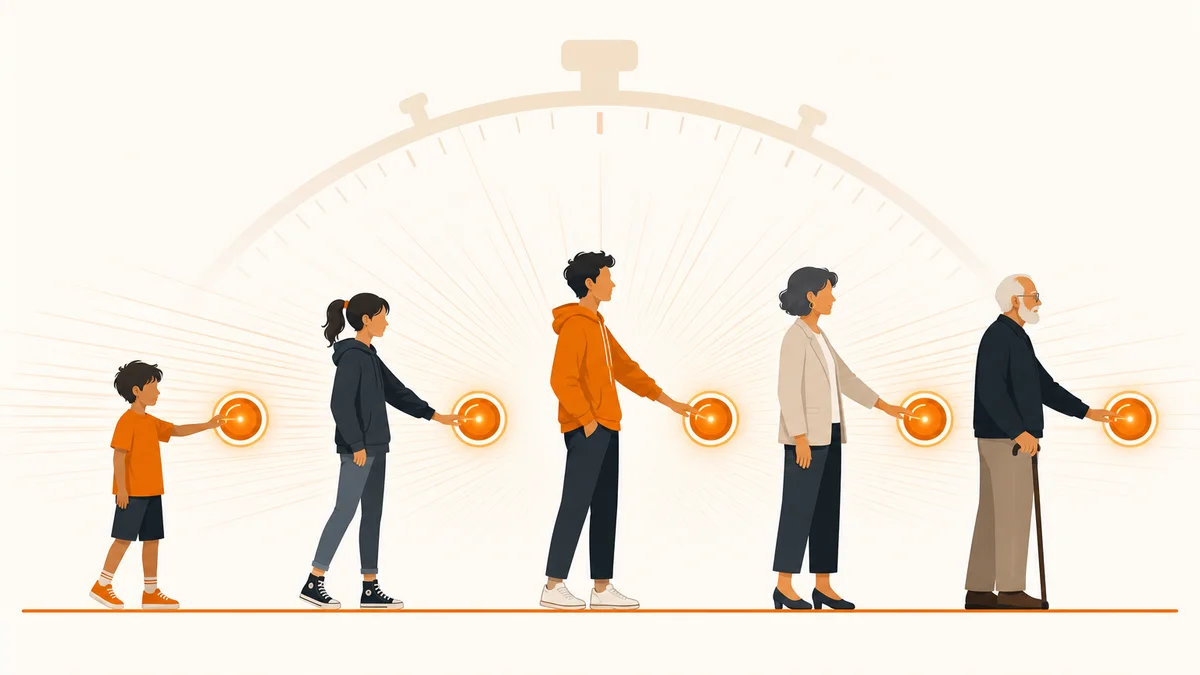
The average human reaction time is about 200 to 250 milliseconds (ms) for a simple visual signal, like clicking the moment a screen changes color. That is the normal range for a healthy adult in lab studies. Online tests usually read a little slower, because your screen and mouse add delay.
Someone finishes a round on our reaction time test and wants to know one thing: is that number normal?
What Is a Normal Reaction Time?
For a healthy adult, average simple reaction time to a visual stimulus is about 200-250ms, based on large studies including the Baltimore Longitudinal Study of Aging and a 2015 review in Frontiers in Human Neuroscience.
Those numbers are for a visual signal. People usually react faster to a sound than to a flash of light, and we compare the two on our auditory vs visual reaction time page.
Does Age Change the Average?
Yes, but less than most people expect. In the 2015 Frontiers study, average simple reaction time went from about 218ms at ages 18-24 to about 239ms at ages 59-65. Fozard et al.'s Baltimore Longitudinal Study of Aging, which followed 1,265 people aged 17 to 96, found the same slow rate of about 0.5ms a year. So a 65-year-old is only about 20-25ms slower than they were at 20. You could measure that gap in a controlled test, but you wouldn't feel it catching a dropped set of keys.
Children and young teens are slower than adults and less consistent. For the full table, from 10-year-olds to people over 70, see our reaction time by age page.
Simple vs. Choice vs. Go/No-Go: How Test Type Matters
Age isn't the only variable. Which test you take changes the number more than a decade of aging does.
| Test Type | Typical Adult Average | What It Adds |
|---|---|---|
| Simple | 200-250ms | Nothing but raw reflex: one signal, one response |
| Choice | ~300-350ms with four options | A decision step, governed by Hick's Law |
| Go/No-Go | 280-320ms | Impulse control: you have to check before you commit |
This is why comparing your choice reaction score against a "average reaction time is 200ms" headline is comparing the wrong things. Choice reaction time adds roughly 100-150ms on top of simple reaction time just from the extra decision. That's Hick's Law, and it has nothing to do with how sharp your reflexes are. We explain the gap in more detail on simple vs choice reaction time.
Does Gender Affect Reaction Time?
A little, yes. The Baltimore Longitudinal Study of Aging found that men were faster than women across every age group and every task type tested, and the gap was still there when researchers controlled for age. At the 2008 Beijing Olympics, sprinters' starting-block reaction times averaged 166ms for men and 189ms for women, a 23ms gap, in a population where both groups are about as fast as a human being gets.
The gap is real but small next to what practice and training can do. It shrinks with repetition, and it's dwarfed by the age-related differences we covered above once you're comparing people decades apart rather than sexes within the same age group.
What Counts as a Good Reaction Time?
Numbers only mean something with context. Here's roughly how simple visual reaction time breaks down for adults:
| Range | Category |
|---|---|
| Under 150ms | Elite: rare outside trained athletes and gamers |
| 150-200ms | Fast |
| 200-250ms | Above average |
| 250-300ms | Average |
| Over 300ms | Slower than typical: check sleep, distraction, and device lag first |
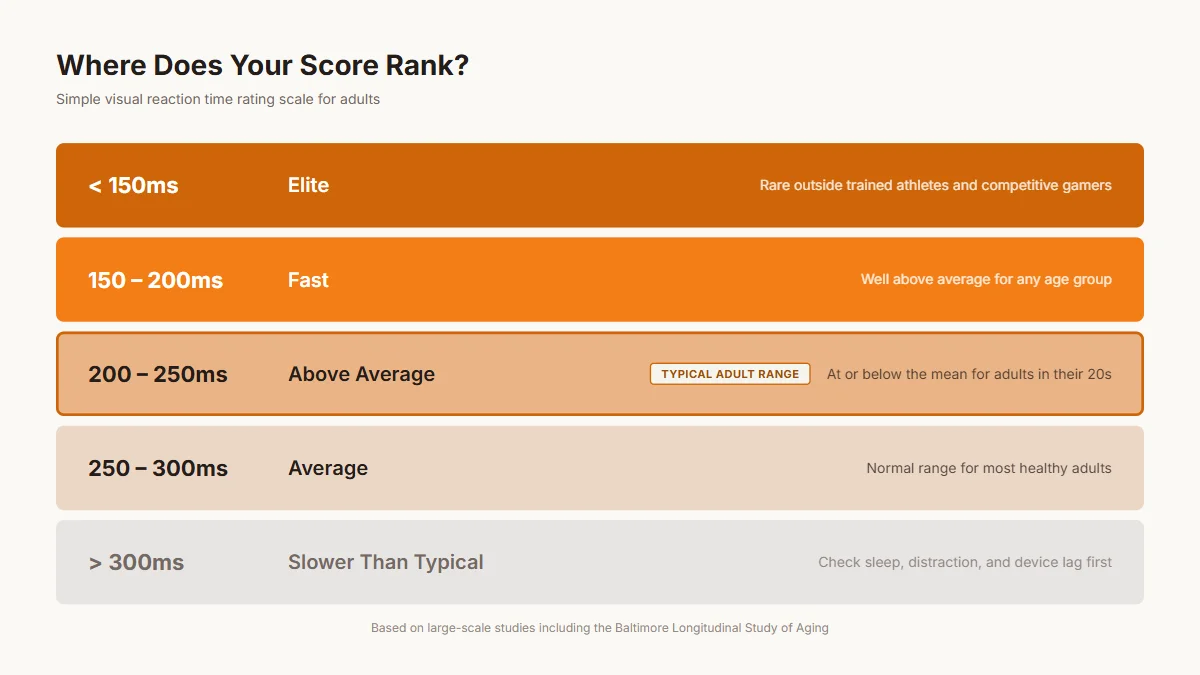
Judge yourself against your own age group, not against a Formula 1 driver. F1 drivers launch their cars about 200ms after the lights go out, and professional Counter-Strike players averaged 219ms on a simple click test in one lab study, but those are people who've spent thousands of hours training exactly this skill under ideal conditions. For a deeper breakdown of where your score sits, see our guide on what counts as a good reaction time, and if gaming benchmarks are what you're after, we've got a full comparison on reaction time for gaming.
Why Online Test Scores Differ from Lab Results
If your score on this site runs a bit higher than the numbers in the table above, that's expected, not a sign you're slow. A lab measures reaction time with dedicated hardware wired directly to a stimulus and a response button. A browser has to go through your monitor, your input device, and the browser's own rendering pipeline first, and each of those adds a small delay: monitor input lag (roughly 5-30ms on most displays), input device lag (1-50ms depending on your mouse or keyboard), and a few extra milliseconds of browser rendering overhead.
Add it up and online scores commonly run 20-60ms slower than equivalent lab measurements. That's exactly why we built this test around performance.now() and requestAnimationFrame, to keep our own measurement error as small as possible, even though we can't eliminate your hardware's contribution. Track your own trend over time rather than chasing an absolute lab number, and you'll get a much more useful signal.
Factors That Affect Your Score
Age explains part of the picture. These explain the rest, and most of them matter more day-to-day than a birthday does:
Sleep is the single biggest modifiable factor. A short night measurably slows reaction time, often more than several years of aging would. Caffeine tends to sharpen reaction time a bit, especially if you're tired to begin with. Exercise and general fitness correlate with faster, more consistent scores. Time of day matters too: most people test faster in the late afternoon than first thing in the morning, a circadian effect. Alcohol does the opposite of caffeine, and the impairment is well documented even at levels well under the legal driving limit.
We go into the evidence and the actual numbers behind each of these on our what affects reaction time page.
Frequently Asked Questions
What is a normal reaction time?
For a healthy adult, a normal simple visual reaction time is about 200-250ms in a lab. On an online test, 250-300ms is typical, because your monitor, mouse and browser each add a little delay. A score anywhere in those ranges is normal.
What is the fastest human reaction time?
A real human reaction can't go much below about 100ms. Elite sprinters react to the starting gun in about 166ms (men) and 189ms (women) on average, and the fastest starts come in around 120ms. Anything under 100ms in a race is ruled a false start, because it's faster than the nervous system can process the signal and respond. See the fastest human reaction time for the full record.
Does reaction time get worse with age?
Yes, but slowly. Simple reaction time increases by roughly 0.5ms per year starting in your twenties, according to the Baltimore Longitudinal Study of Aging. That's a gradual slide, not a cliff, and it's partly offset by sleep, fitness, and practice.
How can I improve my reaction time?
Sleep and practice make the biggest difference for most people, with regular exercise and consistent testing conditions close behind. See our full guide on how to improve reaction time for specific drills and how much improvement to realistically expect.
Test where you stand