Reaction Time by Age: Average Reaction Time at Every Stage of Life

Ask two people what age does to reaction time and you'll usually get two wrong answers. One thinks reflexes fall off a cliff at 40. The other thinks age barely matters at all. The real curve is slower and steadier than either guess, and you can see where you land on it with a quick reaction time test.
Reaction time by age follows one clear shape. It drops fast through childhood, bottoms out in your early-to-mid 20s, then drifts back up by roughly half a millisecond every year for the rest of your life. Here is the whole arc, stage by stage, and the biology driving each part of it.
Average reaction time by age group
On a simple visual test, where you react to a single signal as fast as you can, a healthy adult averages 200 to 250 milliseconds (ms). It moves with age like this:
| Age group | Average simple reaction time | What's happening |
|---|---|---|
| Under 10 | Slower than teens, highly variable | Nervous system still wiring up |
| 10-17 | Slower than adults until the mid-teens | Closing in on adult speed |
| 18-24 | ~218ms | The fastest years |
| 25-31 | ~221ms | Still basically at peak |
| 32-45 | ~225-228ms | Slowing starts, too small to feel |
| 46-58 | ~234-236ms | Steady half-a-millisecond-a-year drift |
| 59-65 | ~239ms | Slower, and less consistent |
| 65+ | ~245-260ms (estimated) | Decline continues, variability grows |
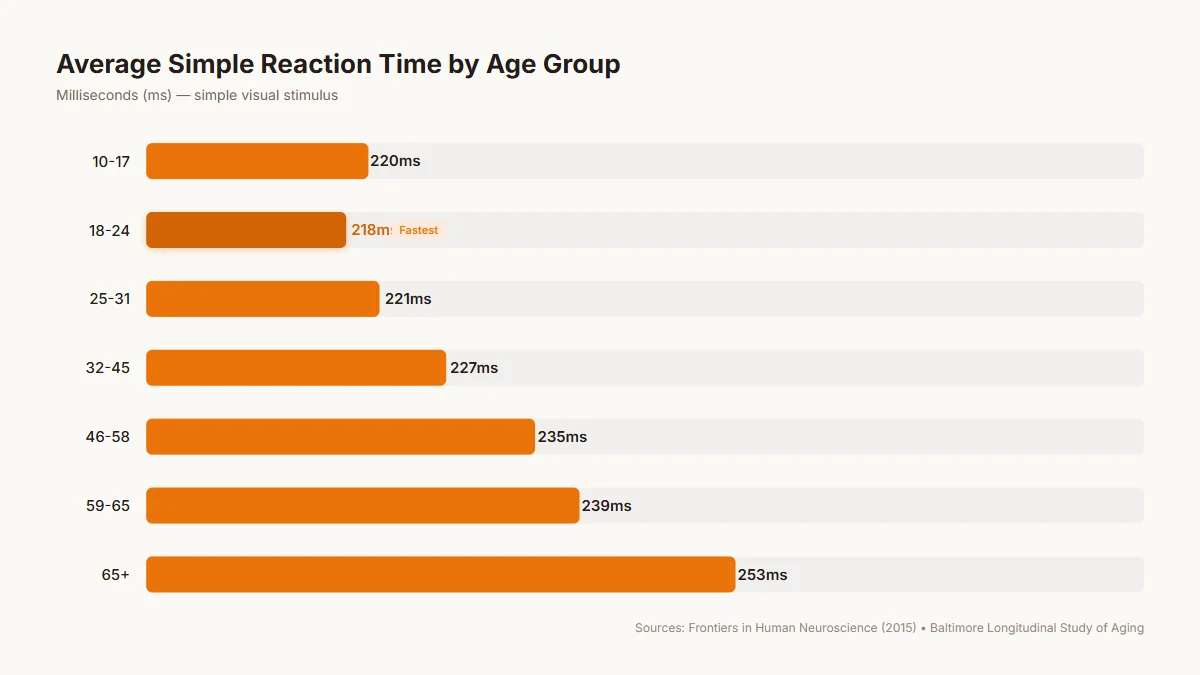
The adult figures come from a 2015 Frontiers in Human Neuroscience study by Woods and colleagues, which measured seven age groups from 18 to 65. The page also draws on the Baltimore Longitudinal Study of Aging, which tracked 1,265 people aged 17 to 96, and on Welford's 1980 review of decades of reaction-time research. If you want the broader picture of how these figures were measured and how to read your own score, our average reaction time overview covers it. This page goes deeper on the age curve itself.
Average reaction time at specific ages
Here are the averages for single ages on a simple visual test, in milliseconds and in seconds:
| Age | Average simple reaction time | In seconds | Notes |
|---|---|---|---|
| 10 | Slower than adults | No fixed figure | Child studies use different setups, so their numbers don't line up with adult data. Scores swing a lot from try to try |
| 14 | A little slower than adults | No fixed figure | Nearly at adult speed. By 15 to 18, teens test the same as adults in their 20s |
| 18 | ~218ms | 0.218s | Measured, ages 18-24. The fastest group |
| 25 | ~221ms | 0.221s | Measured, ages 25-31 |
| 40 | ~228ms | 0.228s | Measured, ages 39-45 |
| 50 | ~234ms | 0.234s | Measured, ages 46-51 |
| 60 | ~239ms | 0.239s | Measured, ages 59-65 |
| 70+ | ~245-260ms (estimated) | ~0.245-0.260s | Estimated from the 0.5ms-a-year rate. People also get less consistent |
The 18 to 60 rows are the measured group averages from the Woods study. The 70+ row is an estimate, because that study stopped at 65. It extends the Baltimore study's rate of about 0.5ms a year. For children, a 2017 study by Bucsuházy and Semela tested ages 3 to 18 against adults aged 20 to 30. It found no real difference between 15- to 18-year-olds and the adults, while younger children were slower. That study timed a different task, so its millisecond values don't transfer to this table. That's why the 10 and 14 rows give no figure.
Childhood: the steep climb toward adult speed
A five-year-old is slow, and not because they aren't trying. A young child can take several times as long as an adult to respond to a signal, and their scores bounce around wildly from one try to the next.
The reason is physical. A child's nerves are still getting insulated. Nerve fibers get wrapped in a fatty coating called myelin (think of it as insulation on a wire that lets the signal travel faster), and that wrapping keeps building into the teenage years. More myelin means quicker signals and steadier scores.
By the mid-teens most of that work is done. A 14-year-old already scores close to a 20-year-old on a simple test. The gains left after that are small.
The peak: your early-to-mid 20s
This is as fast as you get. Somewhere around 18 to 24, the wiring is fully built and nothing has started to wear yet. Welford's review put the low point of the whole reaction-time curve right here, and the Baltimore data agrees.
Notice how flat the top of the curve is, though. The jump from the 18-24 group to the 32-45 group is under 10ms. That's smaller than the difference one bad night of sleep can make. So if you're 30 and your scores match your college numbers, nothing is wrong with you. You're sitting on the flat part of the peak.
The slow decline, and why it happens
After the peak, reaction time creeps up by about 0.5ms per year. Do the math and a 65-year-old is only 20 to 25 ms slower than they were at 20. Real, measurable in a controlled test, and almost impossible to notice while catching a dropped set of keys.
So what's actually slowing down? Reaction time is a relay race. A signal hits your eye, runs down a nerve, gets processed in the brain, and fires a muscle. Age taps the brakes on every leg of that race. The speed a signal travels along a nerve (nerve conduction velocity) drops a little each decade as the myelin insulation thins. And where one neuron hands the signal off to the next, it does that with chemicals called neurotransmitters, which get slightly slower and less precise too. No single one of these is dramatic. Stacked across the whole relay, over 40 years, they add up to the gentle climb in the table.
How this compares to other kinds of aging
Here's the part that surprises people: reaction time is one of the slowest-declining things about getting older. Memory, quick problem-solving, the speed you learn something new, those tend to slip earlier and faster than raw reaction speed does.
Simple reaction time leans mostly on hardware that stays in decent shape: the nerve-to-muscle path. That path wears slowly. A 70-year-old who has lost a step on remembering names can still post a simple reaction time within a hair of a 30-year-old's, because the two abilities run on different machinery.
One caveat. The moment you add a decision to the test, age bites harder. On a choice test, where you have to pick the right response out of several, the gap between young and old widens, because now you're testing thinking speed, not just reflex. Choice reaction time starts slipping earlier, sometimes as young as the 30s. Pure reflex holds on much longer.
What older adults can actually do about it
Plenty, as it turns out, because most of what shapes a single score has nothing to do with your birthday.
Sleep is the big one. A short night slows almost anyone more than a decade of aging would, and that works in your favor: fix your sleep and you claw back time no matter your age. Regular exercise keeps scores faster and steadier, and the effect shows up in older adults specifically, not just the young. Practice helps too. The brain still adapts at 70; it just adapts a bit slower than it did at 20.
None of this reverses the biology. You won't out-train your 20-year-old self. But a rested, fit 60-year-old routinely beats a tired, sedentary 30-year-old on the same test, and that tells you exactly where to spend your effort.
Frequently asked questions
What is the average reaction time for a 14-year-old?
A 14-year-old is usually a little slower than an adult on the same test. There is no single lab figure for this age that compares cleanly with adult data, because studies of children use different setups. Research does show the gap closes fast: 15- to 18-year-olds test about the same as adults in their 20s, whose average simple visual reaction time is about 218ms.
What is the average reaction time for a 10-year-old?
A 10-year-old is noticeably slower than an adult and far less consistent from one try to the next. The nervous system is still developing at this age. Exact numbers depend heavily on how the test is run, so compare a child's score with their own earlier scores, not with adult averages.
At what age is reaction time fastest?
Between about 18 and 24. In a 2015 study of seven adult age groups, 18- to 24-year-olds averaged about 218ms on a simple visual test, the fastest of any group. People aged 25 to 31 were only about 3ms slower.
Does reaction time slow down after 40?
Only a little. Simple reaction time slows by about half a millisecond a year through adulthood, so a 40-year-old averages roughly 228ms against 218ms for someone aged 18 to 24. A large UK survey of 7,130 adults found that simple reaction time barely slows until around 50, while choice reaction time slows across the whole adult age range.
The short version
Reaction time by age is a long, shallow curve, not a cliff. You climb fast as a kid, peak in your early 20s, then give back about half a millisecond a year while the rest of the machinery ages around you. It slows later and gentler than most of the mind does, and how you sleep and move matters more, day to day, than the number of candles on the cake. Take the reaction time test and see where you sit on the curve.
Test where you stand